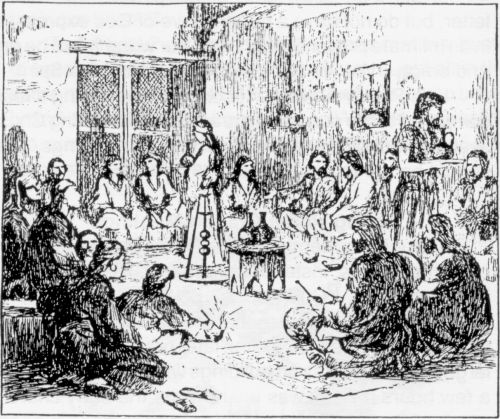
The Layout Of The Meeting
Before I begin I would like to say one thing, that in all things we as the Church must be careful so as not to take things by the letter of the law, but by the Spirit.
In today’s American church the set up is very much the same. One pastor, two to three elders; perhaps a deacon, Sunday school teachers, and the usual crowd that shows up each Sunday. On a normal given Sunday around 9:00am Sunday school starts ending around 10:00am. Then from 10:30am worship starts with around five songs pre-picked by the worship leader, perhaps to better suite the pastor’s sermon. Following the time of worship the pastor relays his message for the day, after this everyone rises to leave and the meeting of the body of Christ is over. Now I want to be careful on how I write this, for to some this may seem over the top. Is the diagram of the church layout in American society scriptural? At this point I could do as many believers do when writing about Theology and Christian living, I could ramble on and on about my own knowledge. I will do that most likely, be assured, but first I believe we need to look to the scriptures first.
Order In the Church, Order In The Church
In 1 Corinthians 14, Paul is dealing with order in the church, something I believe has been abused in the denominational church and yet forgotten by many of the home churches.
1 Corinthians 14:23-26
If therefore the whole church be come together into one place, and all speak with tongues, and there come in those that are unlearned, or unbelievers, will they not say that ye are mad?
But if all prophesy, and there come in one that believeth not, or one unlearned, he is convinced of all, he is judged of all:
And thus are the secrets of his heart made manifest; and so falling down on his face he will worship God, and report that God is in you of a truth.
¶How is it then, brethren? when ye come together, every one of you hath a psalm, hath a doctrine, hath a tongue, hath a revelation, hath an interpretation. Let all things be done unto edifying.
In verse 23-24, notice that Paul gives an hypothesis; a what if. That what if, is that if all the church comes together, and all speak with tongues. These verses immediately raise a question in my mind. How could all speak in tongues or prophesy if on Sunday it is the pastor who shares his message? Paul shows in vs. 26 the answer to this seemingly confusing mishap between today’s church and the scriptures. He first asks a question. How is it then, brethren? Or, How should it be brothers? The way the church should function when together is everyone either has a psalm, doctrine, tongue, revelation, or interpretation. We must remember that we are the body of Christ. How useful is an arm that plays not out its role for the body? It is useless. So then we as the body of Christ should all be moving and working for the sole purpose that the rest of the body might be edified to the glory of the Lord.
1 Corinthians 12:4-12
Now there are diversities of gifts, but the same Spirit.
And there are differences of administrations, but the same Lord.
And there are diversities of operations, but it is the same God which worketh all in all.
But the manifestation of the Spirit is given to every man to profit withal.
For to one is given by the Spirit the word of wisdom; to another the word of knowledge by the same Spirit;
To another faith by the same Spirit; to another the gifts of healing by the same Spirit;
To another the working of miracles; to another prophecy; to another discerning of spirits; to another divers kinds of tongues; to another the interpretation of tongues:
But all these worketh that one and the selfsame Spirit, dividing to every man severally as he will.
¶For as the body is one, and hath many members, and all the members of that one body, being many, are one body: so also is Christ.
So what things could be done in the church for the edification of the church? Well one of course is teaching, which teaching is a gift. So let us look at another great passage.
Ephesians 4:9-16
(Now that he ascended, what is it but that he also descended first into the lower parts of the earth?
He that descended is the same also that ascended up far above all heavens, that he might fill all things.)
And he gave some, apostles; and some, prophets; and some, evangelists; and some, pastors and teachers;
For the perfecting of the saints, for the work of the ministry, for the edifying of the body of Christ:
Till we all come in the unity of the faith, and of the knowledge of the Son of God, unto a perfect man, unto the measure of the stature of the fulness of Christ:
That we henceforth be no more children, tossed to and fro, and carried about with every wind of doctrine, by the sleight of men, and cunning craftiness, whereby they lie in wait to deceive;
But speaking the truth in love, may grow up into him in all things, which is the head, even Christ:
From whom the whole body fitly joined together and compacted by that which every joint supplieth, according to the effectual working in the measure of every part, maketh increase of the body unto the edifying of itself in love.
Following the ascension of Christ into glory, the anointing of the Holy Ghost, gifts were given. As the purpose of the saints is to edify the body as shown in the previous passage, God has supplied gifts to His children that they might better build up the body of Christ. Now let us carefully look at each one of these gifts. Let us scrutinize and not legalize.
Before I begin I would like to say one thing, that in all things we as the Church must be careful so as not to take things by the letter of the law, but by the Spirit.
In today’s American church the set up is very much the same. One pastor, two to three elders; perhaps a deacon, Sunday school teachers, and the usual crowd that shows up each Sunday. On a normal given Sunday around 9:00am Sunday school starts ending around 10:00am. Then from 10:30am worship starts with around five songs pre-picked by the worship leader, perhaps to better suite the pastor’s sermon. Following the time of worship the pastor relays his message for the day, after this everyone rises to leave and the meeting of the body of Christ is over. Now I want to be careful on how I write this, for to some this may seem over the top. Is the diagram of the church layout in American society scriptural? At this point I could do as many believers do when writing about Theology and Christian living, I could ramble on and on about my own knowledge. I will do that most likely, be assured, but first I believe we need to look to the scriptures first.
Order In the Church, Order In The Church
In 1 Corinthians 14, Paul is dealing with order in the church, something I believe has been abused in the denominational church and yet forgotten by many of the home churches.
1 Corinthians 14:23-26
If therefore the whole church be come together into one place, and all speak with tongues, and there come in those that are unlearned, or unbelievers, will they not say that ye are mad?
But if all prophesy, and there come in one that believeth not, or one unlearned, he is convinced of all, he is judged of all:
And thus are the secrets of his heart made manifest; and so falling down on his face he will worship God, and report that God is in you of a truth.
¶How is it then, brethren? when ye come together, every one of you hath a psalm, hath a doctrine, hath a tongue, hath a revelation, hath an interpretation. Let all things be done unto edifying.
In verse 23-24, notice that Paul gives an hypothesis; a what if. That what if, is that if all the church comes together, and all speak with tongues. These verses immediately raise a question in my mind. How could all speak in tongues or prophesy if on Sunday it is the pastor who shares his message? Paul shows in vs. 26 the answer to this seemingly confusing mishap between today’s church and the scriptures. He first asks a question. How is it then, brethren? Or, How should it be brothers? The way the church should function when together is everyone either has a psalm, doctrine, tongue, revelation, or interpretation. We must remember that we are the body of Christ. How useful is an arm that plays not out its role for the body? It is useless. So then we as the body of Christ should all be moving and working for the sole purpose that the rest of the body might be edified to the glory of the Lord.
1 Corinthians 12:4-12
Now there are diversities of gifts, but the same Spirit.
And there are differences of administrations, but the same Lord.
And there are diversities of operations, but it is the same God which worketh all in all.
But the manifestation of the Spirit is given to every man to profit withal.
For to one is given by the Spirit the word of wisdom; to another the word of knowledge by the same Spirit;
To another faith by the same Spirit; to another the gifts of healing by the same Spirit;
To another the working of miracles; to another prophecy; to another discerning of spirits; to another divers kinds of tongues; to another the interpretation of tongues:
But all these worketh that one and the selfsame Spirit, dividing to every man severally as he will.
¶For as the body is one, and hath many members, and all the members of that one body, being many, are one body: so also is Christ.
So what things could be done in the church for the edification of the church? Well one of course is teaching, which teaching is a gift. So let us look at another great passage.
Ephesians 4:9-16
(Now that he ascended, what is it but that he also descended first into the lower parts of the earth?
He that descended is the same also that ascended up far above all heavens, that he might fill all things.)
And he gave some, apostles; and some, prophets; and some, evangelists; and some, pastors and teachers;
For the perfecting of the saints, for the work of the ministry, for the edifying of the body of Christ:
Till we all come in the unity of the faith, and of the knowledge of the Son of God, unto a perfect man, unto the measure of the stature of the fulness of Christ:
That we henceforth be no more children, tossed to and fro, and carried about with every wind of doctrine, by the sleight of men, and cunning craftiness, whereby they lie in wait to deceive;
But speaking the truth in love, may grow up into him in all things, which is the head, even Christ:
From whom the whole body fitly joined together and compacted by that which every joint supplieth, according to the effectual working in the measure of every part, maketh increase of the body unto the edifying of itself in love.
Following the ascension of Christ into glory, the anointing of the Holy Ghost, gifts were given. As the purpose of the saints is to edify the body as shown in the previous passage, God has supplied gifts to His children that they might better build up the body of Christ. Now let us carefully look at each one of these gifts. Let us scrutinize and not legalize.
The Five Gifts Of Ephesians
Apostles
apostolos -- pronounced: ap-os'-tol-os
from 649; a delegate; specially, an ambassador of the Gospel; officially a commissioner of Christ ("apostle") (with miraculous powers): KJV -- apostle, messenger, he that is sent.
In today’s words: a missionary. Although many argue that there are no longer apostles these today’s, that is simply untrue. If anything, there are more sent out into all the world then there were in the early church, due of course to the growth of the church since then.
Prophets
profetes -- pronounced: prof-ay'-tace
from a compound of 4253 and 5346; a foreteller ("prophet"); by analogy, an inspired speaker; by extension, a poet: KJV -- prophet.
Although throughout the Old Testament a prophet usually spoke of future events, the gift of prophesy is more then that alone. A prophet is merely one who speaks at a certain moment by the very inspiration of God.
Evangelists
euangelistes -- pronounced: yoo-ang-ghel-is-tace'
from 2097; a preacher of the gospel: KJV -- evangelist.
The evangelist is much like the apostle, only instead of being sent out from the local body of believers into the world, he rather remains local as a preacher of the gospel.
Pastors
poimen -- pronounced: poy-mane'
of uncertain affinity; a shepherd (literally or figuratively): KJV -- shepherd, pastor.
Although today’s American church would view otherwise, I look at the gift of pastor as merely one, who just as a shepherd, watches out and cares for the spiritual and physical needs of the body. This is the same command to the elders. In fact the same Greek word for pastors used in Ephesians 4 is the same Greek word for elders used in 1 Peter. Peter exhorts the elders to feed the flock. He goes further by saying they need not be lords over the flock, but rather examples. (1 Peter 5:1,3) For, there is only One Shepherd who is Lord over the flock, the others just care for them as examples to the others to do so as well. Todays church view of a pastor is a mix-mash of both teacher and pastor into one. I am not saying that a pastor cannot have the gift of teaching, but that the gift of teaching is different from the gift of pastoring. I believe that an elder and a pastor are dealing with the same gift and calling as they both come from the same Greek word.
Teachers
didaskalos -- pronounced: did-as'-kal-os
from 1321; an instructor (genitive case or specially): KJV -- doctor, master, teacher.
This gifting is simply having a better ability to project the truth of the word to the believers, whether it is the tough meat for the mature believer, or the milk for the newly saved.
The Five Bars Of The Tabernacle
If we turn to the Old Testament we will find a great picture of what Corinthians 4 is describing. In almost every aspect the Old Testament was historical, but it also extends further as a picture how of the church was to work.
Exodus 26:26-28
And thou shalt make bars of shittim wood; five for the boards of the one side of the tabernacle,
And five bars for the boards of the other side of the tabernacle, and five bars for the boards of the side of the tabernacle, for the two sides westward.
And the middle bar in the midst of the boards shall reach from end to end.
If you have ever built a fence before you would know that if you leave your fence posts standing in the ground alone for to long, the weather and elements of the climate will begin to twist and warp the posts. But if you place your fencing on immediately, your posts will remain straight and stable, come what may. The tabernacle was much the same way in its design. It’s posts or boards as described were held together by five bars, one of which reached from one end to the other. If you turn to Ephesians 2:20 you will find that the Apostles and Prophets were the foundation of the church. I believe that middle bar as found in Exodus could very well be a picture of the evangelist, as the calling of making disciples is sent forth to all the saints. But that is up for interpretational debate. What I am trying to show in these scriptures from both the old and new Testament is that without the five bars or the five gifts in use, the boards of the church will over time become twisted and deformed perhaps even beyond repair. If all the gifts are not in use the walls of the church are in dire danger. So many churches today mark off apostles and prophets as being a thing of the past. Then they take the gifts of pastor and teacher and try to squeeze them together into some mega gift that certain people with a degree obtain. All in all by doing so, the church at large has removed the foundation of the church, the apostles and prophets, and has taken away the working of the Spirit in the midst of the meetings by simply handing out gifts in the form of a paper diploma. This is not found in scripture nor is it seen in early church history. We must be careful so as not to hinder the Holy Ghost, and we must needs be cautious so as not to mold the church in an unbiblical setting for the sake of traditional secular ways. Scriptural truth must supercede all human notions of church function.
“All Ye Are Brethren”
Matthew 23:8-12
But be not ye called Rabbi: for one is your Master, even Christ; and all ye are brethren.
And call no man your father upon the earth: for one is your Father, which is in heaven.
Neither be ye called masters: for one is your Master, even Christ.
But he that is greatest among you shall be your servant.
And whosoever shall exalt himself shall be abased; and he that shall humble himself shall be exalted.
The intent that God seems to make so very clear for the church is that we are all on one level, that level is simply based upon the calling and working of God. This is clearly lost in the Catholic Church. Going from the Pope down to the priest, this is considered the positions that God speaks through in the Catholic religion. The congregation has no need for biblical studies, just the hearing of the daily sermon from the priest. We can see how this goes against what God desired from the beginning. Turn to Exodus and there we will find that with Israel, God desired to speak directly to them Himself. He no longer wanted them to have to go through Moses, He desired a relationship with them. Yet it was due to their sin that they could not all hear from God but had to wait for Moses to bring the word of God to them.
Exodus 20:18-22
¶And all the people saw the thunderings, and the lightnings, and the noise of the trumpet, and the mountain smoking: and when the people saw it, they removed, and stood afar off.
And they said unto Moses, Speak thou with us, and we will hear: but let not God speak with us, lest we die.
And Moses said unto the people, Fear not: for God is come to prove you, and that his fear may be before your faces, that ye sin not.
And the people stood afar off, and Moses drew near unto the thick darkness where God was.
¶And the LORD said unto Moses, Thus thou shalt say unto the children of Israel, Ye have seen that I have talked with you from heaven.
The Lord desired greatly to be able to speak directly to His people. But because they were fearful and unbelieving and because the Spirit of the God was not in them, they left the task for one man to bring to them. In the end the Lord took this burden from Moses and laid it upon the priests and prophets of the tabernacle. But as seen in Acts, after the ascension of Christ to His throne, by the power of the Holy Ghost to which He left for the church, we have all become priests. It is not left to only a certain tribe, but to one tribe, the tribe of Jesus Christ.
Acts 2:1
¶And when the day of Pentecost was fully come, they were all with one accord in one place.
And suddenly there came a sound from heaven as of a rushing mighty wind, and it filled all the house where they were sitting.
And there appeared unto them cloven tongues like as of fire, and it sat upon each of them.
And they were all filled with the Holy Ghost, and began to speak with other tongues, as the Spirit gave them utterance.
1 Peter 2:9-10
But ye are a chosen generation, a royal priesthood, an holy nation, a peculiar people; that ye should shew forth the praises of him who hath called you out of darkness into his marvellous light:
Which in time past were not a people, but are now the people of God: which had not obtained mercy, but now have obtained mercy.
So Christ has made us all partakers in the church. As priests we all have our duties before God to perform in the meeting. If we heed not the working of the Spirit but rather stand back due to the schedule or layout of the traditional church, so prevalent in America, we become a useless part on the body of Christ. God forbid that we should become that. As Peter puts it, we are a royal priesthood. Let us be faithful to the calling and duties to which God so desires to work through us for the edification, admonition, encouragement, and even correction of the brethren around us. If we slack in our work, the fence posts of the church will become twisted and unworkable in hard times, and in due time even non-repairable. I fear the traditional church is already there. Let us take caution in this world, and action in the Word of God.
Wells Of Salvation
John 4:13-14, 21-24
Jesus answered and said unto her, Whosoever drinketh of this water shall thirst again:
But whosoever drinketh of the water that I shall give him shall never thirst; but the water that I shall give him shall be in him a well of water springing up into everlasting life.
Jesus makes it clear to the woman at the well. It is from Him that we receive the water of life, and that by Him we will have a well springing up inside of us. Isaiah prophesied of this in chapter 12.
.Isaiah 12:3-4
Therefore with joy shall ye draw water out of the wells of salvation.
¶And in that day shall ye say, Praise the LORD, call upon his name, declare his doings among the people, make mention that his name is exalted.
The Lord has made us wells of salvation. As wells of salvation the church is able to draw from one another. As vs.4 shows that we not only draw from the brethren, but we also must spring forth the truth and declare the doings of the Lord among the people. This is what the Lord desired to do with Israel in Exodus, and what Christ stated as being done through Him. The well springing up was no longer subject to the Levite priests, but rather to the whole church; for we all are priests. Jesus continues in Gospel of John, showing that not only is the Spirit now working in all for the edification of the saints, but that He is not limited to location. He works where He wants and how He wants for the one purpose: to accomplish God’s eternal purpose.
John 4:21-24
Jesus saith unto her, Woman, believe me, the hour cometh, when ye shall neither in this mountain, nor yet at Jerusalem, worship the Father.
Ye worship ye know not what: we know what we worship: for salvation is of the Jews.
But the hour cometh, and now is, when the true worshippers shall worship the Father in spirit and in truth: for the Father seeketh such to worship him.
God is a Spirit: and they that worship him must worship him in spirit and in truth.
Then He explains that worship of the Lord among the saints is no longer subject to physical locations such as the temples in Jerusalem or the mountains of Israel. So bodily ministry is not something that the “home churches” do, but it is something all fellowships when meeting together should be practicing. Whether it is the mid week Bible study or the Sunday morning meeting, the Church needs to be listening to the voice of the Lord and allowing Him to use them at any give moment, so that all may draw from the well Christ has placed in them. I am not saying that all men are teachers, but all men should be open to teach should the Lord desire to have them do so. 2 Timothy 2:23 shows us that “the servant of the Lord must be apt to teach.” Let us not hinder the working of the Holy Ghost, but let us spring forth the river life that should be, if not is, flowing out from our inner most being. We are one body, the body of Christ Jesus, let us act as such that God might be glorified, the saints be edified, and the lost be mystified as they were in Acts 2.
